


Magnesium for kids comes mainly from food such as nuts, seeds, beans, whole grains, and leafy greens, since it is an essential mineral. The NIH sets daily needs at 80 mg for ages 1–3, 130 mg for ages 4–8, and 240 mg for ages 9–13. Evidence that magnesium supplements help children sleep is limited, so talk with your pediatrician before starting one.
What Does Magnesium Do for Kids?
Magnesium is a mineral found throughout the body. The National Institutes of Health (NIH) Office of Dietary Supplements describes it as a nutrient involved in many of the body's everyday processes, including normal muscle and nerve function, and it is part of bone.
It also works with other nutrients. Calcium and magnesium are both found in bone, and vitamin D helps the body handle calcium. That is why you will often see these nutrients together in children's bone-support products.*
Magnesium is a nutrient, not a treatment. This article covers what the research says about intake and safety. It does not cover conditions such as attention, anxiety, mood, or behavior. If you have questions about those, they belong with your pediatrician.
How Much Magnesium Do Kids Need by Age?
The NIH publishes two sets of numbers. The first is how much children need each day. The second is an upper limit for magnesium from supplements. Here are both, taken from the NIH Office of Dietary Supplements fact sheet.
| Age | Daily amount (food and supplements combined) | Upper limit (supplements and medications only) |
|---|---|---|
| Birth to 6 months | 30 mg | Not established |
| 7–12 months | 75 mg | Not established |
| 1–3 years | 80 mg | 65 mg |
| 4–8 years | 130 mg | 110 mg |
| 9–13 years | 240 mg | 350 mg |
| 14–18 years | 410 mg (boys), 360 mg (girls) | 350 mg |
For babies under 12 months, the numbers shown are "adequate intakes," an estimate of what healthy babies get, mostly from breast milk or formula. For ages 1 and up, they are recommended dietary allowances.
What does the upper limit mean?
The upper limit is the most magnesium from supplements and medications that is unlikely to cause problems for most children of that age. The NIH says these limits include only magnesium from dietary supplements and medications. They do not include magnesium that occurs naturally in food and drinks.
This matters because the upper limit for a toddler (65 mg) is lower than the toddler's daily amount (80 mg). That is not a mistake. Food-based magnesium is not counted toward the limit, so most of a young child's magnesium should come from meals.
The limit counts every source, so add up all supplements and medicines your child takes. A children's multivitamin, a calcium product, and a magnesium product can each contain magnesium. For babies under 12 months, the NIH has not set an upper limit, so ask your pediatrician before giving any magnesium supplement.
Where Do Kids Get Magnesium?
Most magnesium should come from food. The NIH lists these sources:
- Legumes such as beans and lentils
- Nuts and seeds
- Whole grains
- Green leafy vegetables such as spinach
- Fortified breakfast cereals and other fortified foods
- Milk, yogurt, and other milk products
Easy ways to add them: nut or seed butter in oatmeal, hummus with whole-grain crackers, beans in soups, or yogurt with fruit. Whole nuts and some seeds are choking hazards for young children, so use butters or age-appropriate textures.
Do Kids Need a Magnesium Supplement?
Many children do not need one, and a supplement is not a substitute for meals.
The NIH notes that some groups are more likely to get too little magnesium, including people with gastrointestinal conditions such as Crohn's disease or celiac disease, and people with type 2 diabetes. It also says teenagers are among those most likely to have low intakes. If your child has a medical condition, a very limited diet, or you are worried about how they eat, ask your pediatrician or a registered dietitian whether anything is worth adding.
A supplement can make sense when a clinician says so. It is not something to start because of a social media post. If you do choose one, pick a product made for children and follow the label.
Magnesium for Kids Sleep: Does It Help? What We Know
This is the question behind most searches for "magnesium for kids sleep," so here is the plain answer: the evidence in children is limited.
What pediatric experts say. Pediatric sleep physician Dr. Craig Canapari reviewed the research and concluded there is no evidence that magnesium supplementation helps with children's sleep, describing the pediatric evidence as very limited. Allegro Pediatrics, a pediatric practice, likewise reports that it found no published clinical studies showing that magnesium supplements improve sleep in children.
Why adult studies don't settle it. Some adult studies suggest magnesium may help certain people sleep better, but results have been inconsistent, and children are not small adults. Adult findings cannot be assumed to apply to a 3-year-old or a 10-year-old.
What has stronger support: the basics. Pediatric sleep guidance starts with habits:
- A consistent bedtime and wake time
- A calming routine, such as a bath, a book, and low lights
- Limiting screens before bed
- Avoiding caffeine in the afternoon and evening
- A cool, dark, quiet bedroom
Talk to your pediatrician if your child regularly has trouble falling asleep, snores loudly, wakes often during the night, or seems very tired during the day. Those can have causes that a supplement will not address.
ChildLife does not market its magnesium products for sleep. The product pages describe bone-support nutrients, and this article makes no sleep claim for them.
Is Magnesium Safe for Kids?
Magnesium from food is considered safe. Supplements are different, which is why the NIH set upper limits.
Side effects. The NIH says high intakes of magnesium from supplements and medications can cause diarrhea, nausea, and abdominal cramping. Very high intakes can be dangerous. Stay at or below the label amount, and do not give extra because a child seems to tolerate it.
Medicine interactions. According to the NIH, magnesium can interact with some medicines, including certain antibiotics (tetracyclines and quinolones), bisphosphonates, and some diuretics. Long-term use of some acid-reducing prescription medicines can also lower magnesium levels. If your child takes any prescription medicine, ask your pediatrician or pharmacist before adding a magnesium supplement.
Kidney conditions. The kidneys clear extra magnesium, so children with kidney problems need a doctor's direction before taking any.
Label amounts. Check the label for elemental magnesium per serving, because the weight of a magnesium compound is not the weight of the magnesium in it.
What to Look for in a Children's Magnesium Supplement
If your pediatrician says a supplement is appropriate, this checklist helps you compare labels. It is not a ranking, and no single product suits every child.
-
The child's age is on the label.
Look for directions for your child's age, not an adult dose cut down.
-
Elemental magnesium per serving.
Find the milligrams of magnesium itself in the Supplement Facts panel.
-
Total against the upper limit.
Compare supplement magnesium, from all products combined, with the NIH upper limit for your child's age.
-
The form.
Common forms include citrate, glycinate, and oxide. Absorption and stomach tolerance differ, so ask your pediatrician which is a better fit.
-
A short ingredient list.
Read the other ingredients for sweeteners, flavors, and anything your child is allergic to.
-
A format your child will take.
Liquids, packets, and gummies suit different ages and textures.
-
Clear directions and warnings.
A product should say how much, how often, and when to talk to a doctor.
-
No promises it can't keep.
Be wary of products that claim to treat a condition or "fix" sleep or behavior.
ChildLife Liquid Calcium with Magnesium: What the Label Says
ChildLife Essentials makes two calcium and magnesium products. Both are described on their product pages as supporting healthy bone structure and growth.* They are mineral supplements, so they are not sold as sleep aids.
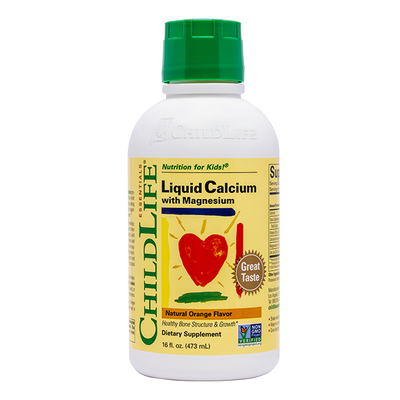
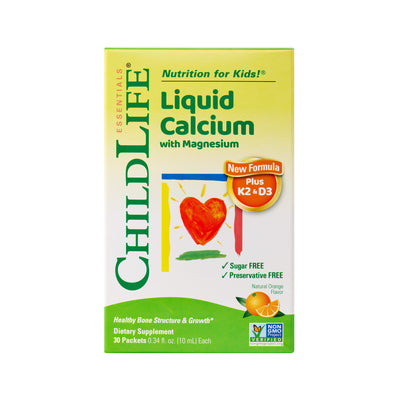
| Liquid Calcium with Magnesium | Liquid Calcium with Magnesium Stick Packs | |
|---|---|---|
| Form | Liquid, 16 fl oz bottle | Single-serve liquid packets |
| Nutrients listed | Calcium, magnesium, zinc, vitamin D3 | Calcium, magnesium, zinc, vitamin D3, vitamin K2 |
| Forms | Citrate forms of calcium, magnesium, and zinc | Citrate forms of calcium, magnesium, and zinc; K2 as MK-7 |
| Label directions, 6–12 months | 1 teaspoon daily | 1 packet daily |
| Label directions, 1–3 years | 2 teaspoons daily | 1 packet daily |
| Label directions, 4+ years | 1 tablespoon, up to 2 times daily | 2 packets daily |
Amounts of each nutrient are printed in the Supplement Facts panel on the product label. Read it before you buy, and compare the magnesium amount with your child's NIH upper limit above.
A few more points:
- The label ingredients differ between the two products, so read the "Other Ingredients" list on the one you choose.
- Both are labeled starting at 6 months. For babies, the NIH has set no upper limit, so ask your pediatrician first.
You can read the full label on each page: Liquid Calcium with Magnesium and Liquid Calcium with Magnesium Stick Packs.
How to Give Magnesium Supplements to Kids Safely
-
Ask first.
Check with your pediatrician before starting, and tell them every supplement and medicine your child takes.
-
Measure carefully.
Use the measuring spoon or packet that comes with the product, not a kitchen spoon.
-
Follow the label.
Do not go above the label amount, and do not double up on a missed dose.
-
Track the total.
Add up magnesium from every supplement, including multivitamins.
-
Watch the stomach.
Loose stools or cramping are a sign to stop and call your pediatrician.
When to Call the Doctor
A magnesium supplement is not a treatment for illness or sleep problems. Call your pediatrician if your child has ongoing trouble sleeping, loud snoring, or daytime exhaustion. Stop the supplement and call if your child has persistent diarrhea, vomiting, or stomach pain. Get emergency help for trouble breathing, extreme weakness, or a very slow or irregular heartbeat.
The Bottom Line
About the reviewer: Dr. Murray Clarke, DNM, D.Hom., L.Ac., is the founder of ChildLife Essentials.
*These statements have not been evaluated by the Food and Drug Administration. This product is not intended to diagnose, treat, cure, or prevent any disease.
Disclaimer: This article is for educational purposes only and is not medical advice. Consult your pediatrician before giving your child any supplement.