


Probiotic drops for infants are liquid supplements that contain live microorganisms, given in a few drops a day. Whether they are appropriate depends on your baby's age and health, and the FDA has warned about probiotics in preterm infants. Talk with your pediatrician before giving any supplement to a newborn, and follow the product label exactly.
What Are Probiotic Drops for Infants?
Probiotics are live microorganisms, usually bacteria, sold as dietary supplements for gut health support.* Infant probiotic drops are liquid versions made for babies. The doses are small, often just a few drops, so they are easy to give and easy to measure.
A few terms help when you read a label:
-
Different products, different bacteria.
The National Center for Complementary and Integrative Health (NCCIH) notes that different probiotic products contain different bacteria, and their effects can differ.
-
CFU.
CFU stands for colony-forming units. It is the number of live organisms per serving, and infant products are often measured in billions.
-
Carrier.
Many drops use an oil base, such as sunflower oil, to carry the live cultures.
Drops are not the only way babies get probiotics. The American Academy of Pediatrics (AAP) notes that some infant formulas for full-term babies already contain probiotics. That is one more reason to tell your pediatrician everything your baby takes.
Probiotics, prebiotics, and synbiotics. These terms often appear side by side on baby products, so it helps to know the difference:
- Probiotics are the live microorganisms themselves.
- Prebiotics are food ingredients, usually types of fiber, that gut bacteria use as fuel. They are not living organisms.
- Synbiotics combine both in one product.
ChildLife InfantBiotics is a probiotic product. Always check the label to see which of these a product contains, because the conversation with your pediatrician can differ for each.
Are Probiotic Drops Safe for Infants?
For healthy, full-term babies, probiotic drops are widely used. But "safe" depends on your baby's age, health, and the specific product, and the evidence has limits. NCCIH says probiotics usually cause few side effects, but long-term safety data are limited. It adds that serious side effects may be more likely in people with underlying health conditions.
Product quality is another factor. Probiotics are dietary supplements, and the FDA has not approved any health claims for probiotics. The AAP points to differences among commercially available probiotic preparations and a lack of regulatory standards in the United States.
What the FDA warned in October 2023
In October 2023, the FDA warned that products containing live microorganisms may present serious risks to preterm infants in hospital settings. The warning followed the death of a preterm infant who developed sepsis after receiving a probiotic product in the hospital. The FDA described an invasive, potentially fatal infection risk and said the concern is especially relevant for very preterm or very low birthweight babies. The FDA also stated that it has not approved any probiotic product for use as a drug or biological product in infants of any age.
What the AAP says
The AAP does not support routinely giving probiotics to preterm infants, particularly those with a birth weight under 1,000 grams (2.2 pounds). Its guidance centers on preterm babies and does not make a general recommendation for healthy full-term infants. It tells families to talk with their child's pediatrician.
What we know, and don't know, about probiotics in babies
Probiotic research is product-specific. A result for one product does not carry over to another, and results in one group of babies don't automatically apply to another. The AAP describes the evidence on probiotics in preterm infants as conflicting, and NCCIH notes that responses to probiotics can vary from person to person. A trustworthy article tells you where the evidence stops, which is why we point you back to your pediatrician rather than promising results.
Who should not take probiotic drops without medical direction
Please do not give probiotic drops to a baby who is:
- Preterm. Born before 37 weeks.
- Hospitalized, including in a neonatal intensive care unit.
- Immunocompromised, meaning the immune system is weakened by a condition or treatment.
- Living with a serious underlying health condition.
The FDA's warning concerned preterm infants in hospitals. Extending the same caution to hospitalized and immunocompromised babies is the careful approach, and in each of these cases the decision belongs to your baby's doctor.
When Can Babies Start Probiotic Drops?
There is no single age that applies to every baby. The label sets the age range for a specific product, and your pediatrician decides whether it fits your baby. The label on ChildLife InfantBiotics Probiotic Drops lists infants from birth to 2 years. A label age range does not replace medical advice, especially for a newborn.
| Your baby | What to do |
|---|---|
| Healthy, full-term newborn | Talk with your pediatrician before giving any supplement. Start only if they agree. |
| Healthy, full-term infant | Check the label age range, follow the directions, and let your pediatrician know. |
| Toddler up to age 2 | Follow the label for the product and tell your pediatrician. |
| Born preterm | Do not give probiotic drops unless your baby's doctor directs it. |
| In the hospital or NICU | Do not give probiotic drops unless the treating team directs it. |
| Weakened immune system or ongoing medical condition | Do not give probiotic drops unless your baby's doctor directs it. |
Questions to bring to your pediatrician
- Is a probiotic appropriate for my baby's age and health history?
- Does this product and its amount make sense for my baby?
- How does my baby's feeding (breast milk, formula, or both) factor in?
- How long should we use it, and what should I watch for?
- Which signs mean I should stop it and call you?
What to Look For in Probiotic Drops for Newborns
Searches for "best probiotic drops for newborns" usually expect a ranked list. We won't rank products here, because no probiotic is best for every newborn, and the first decision is whether your baby needs one at all. If your pediatrician approves, use this checklist to compare any brand, ours included:
-
Age on the label.
Choose a product made and labeled for infants, and confirm it covers your baby's age.
-
CFU per serving and the dose.
Look for the number of live organisms and the exact number of drops.
-
Expiration and storage.
Live cultures can decline with time and heat, so check the date and the storage directions.
-
A short ingredient list.
Check for added sugars, allergens, and extras your baby doesn't need.
-
No disease claims.
Be cautious about any supplement that says it treats or prevents a medical condition. The FDA has stated that it has not approved any probiotic product for use as a drug or biological product in infants of any age.
-
A clear safety statement.
A responsible label or product page tells you who should not use the product without a doctor.
-
A brand you can reach.
Clear contact details make it easier to ask about storage and ingredients.
How to Give Probiotic Drops to a Baby
-
Follow the label amount.
For ChildLife InfantBiotics, the label directs infants from birth to 2 years to take 5 drops daily. Do not give more.
-
Check how to dispense.
Read the dispensing directions on the bottle, and ask your pediatrician whether to give the drops directly or mix them into milk or food.
-
Avoid heat.
Hot foods and hot liquids can harm live cultures, so don't add drops to anything hot.
-
Store it as directed.
The ChildLife label says to store in a cool, dry place. Keep the bottle out of reach of children.
-
One product at a time.
Tell your pediatrician about every supplement, and don't combine probiotic products without their advice.
-
Note the start date.
If something seems off, you'll know exactly when your baby started.
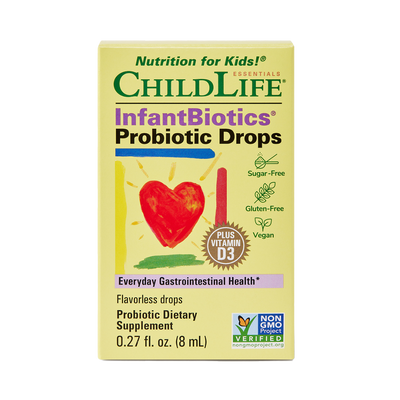
ChildLife InfantBiotics Probiotic Drops: What's on the Label
ChildLife was founded by Dr. Murray Clarke, DNM, D.Hom., L.Ac. Our formulas are doctor-developed and made with non-GMO ingredients. InfantBiotics Probiotic Drops are a daily probiotic supplement for infants, formulated for gut health support.*
| ChildLife InfantBiotics Probiotic Drops | |
|---|---|
| Form | Liquid drops, 0.27 fl oz (8 mL) bottle |
| Label age | Infants from birth to 2 years |
| Label directions | 5 drops daily |
| Potency | 1 billion CFU per serving |
| Base | Sunflower oil |
| Safety note | Talk to your pediatrician before giving any supplement to a newborn. Not for preterm, hospitalized, or immunocompromised babies without medical direction. |
You can see the full Supplement Facts on the InfantBiotics Probiotic Drops product page. To browse more, visit our Baby Essentials collection or the Probiotics collection.
When to Call the Doctor
A probiotic is a supplement, not a treatment for illness. Stop the product and call your pediatrician if your baby has a fever, vomiting, blood in the stool, poor feeding, trouble breathing, unusual sleepiness, or any sign of an allergic reaction, such as hives or swelling. A fever in a newborn needs medical attention right away.
The Bottom Line
About the reviewer: Dr. Murray Clarke, DNM, D.Hom., L.Ac., is the founder of ChildLife Essentials.
*These statements have not been evaluated by the Food and Drug Administration. This product is not intended to diagnose, treat, cure, or prevent any disease.
Disclaimer: This article is for educational purposes only and is not medical advice. Consult your pediatrician before giving any supplement to a newborn. Probiotic products are not for preterm, hospitalized, or immunocompromised babies without medical direction.